nightwright
nightwright turns ideas into shipped code. You capture ideas and explore them until they're clear. You then write them up as short specs with testable acceptance criteria, and hand those specs to an agentic loop that implements, tests, reviews and merges them, coming back to you only when it needs a decision. Along the way, nightwright sees the passive time you spend on each topic.
flowchart LR
    subgraph p1["① Ideas to specs — you, with agents"]
        direction LR
        C["Capture"] --> X["Explore"] --> S["Spec"] --> R["Review"]
    end
    subgraph p2["② The agentic loop — unattended"]
        direction LR
        Q["Queue"] --> I["Implement"] --> G["Gates"] --> V["Review"] --> M["Merge"]
        G -. fix .-> I
        V -. fix .-> I
    end
    R --> Q
    M --> D(["Shipped, with the<br/>whole story in a ledger"])
p2 -. "parks with a reason<br/>when it needs you" .-> H(["You"])-
Capture a thought in seconds, explore it until it's fully fledged, and write a spec that says exactly what "done" means: decision, acceptance criteria, test plan.
-
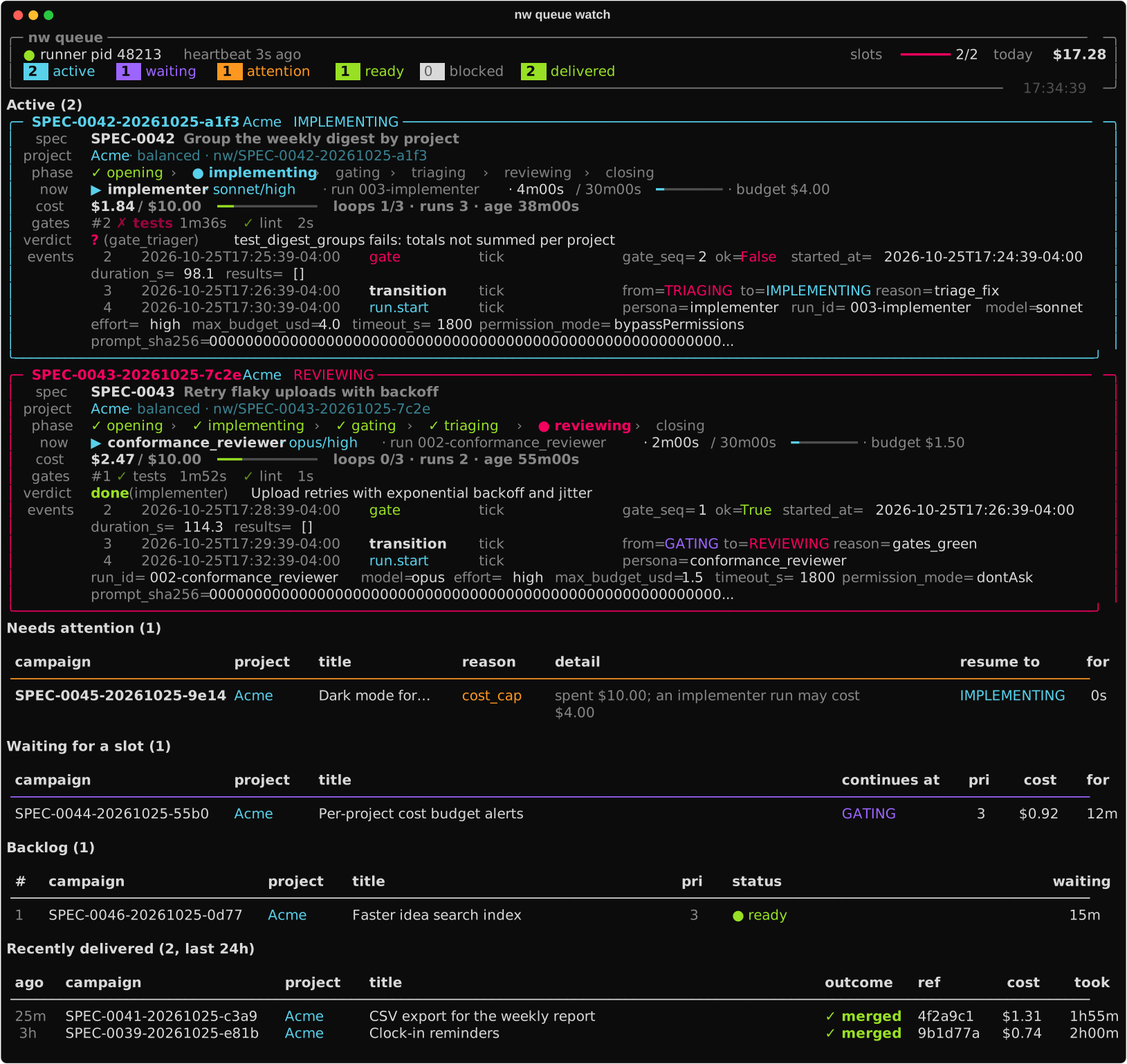
A small, deterministic machine around fresh persona runs. It implements, runs your tests, reviews against the spec and merges, with bounded loops, cost caps and a clear escalation ladder.
-
Nine steps with a check after each: install, configure, register a project, and watch your first spec get built and merged.
-
The everyday path: register projects, start the runner, launch the conductor and a steward per project, queue specs and watch them merge.
-
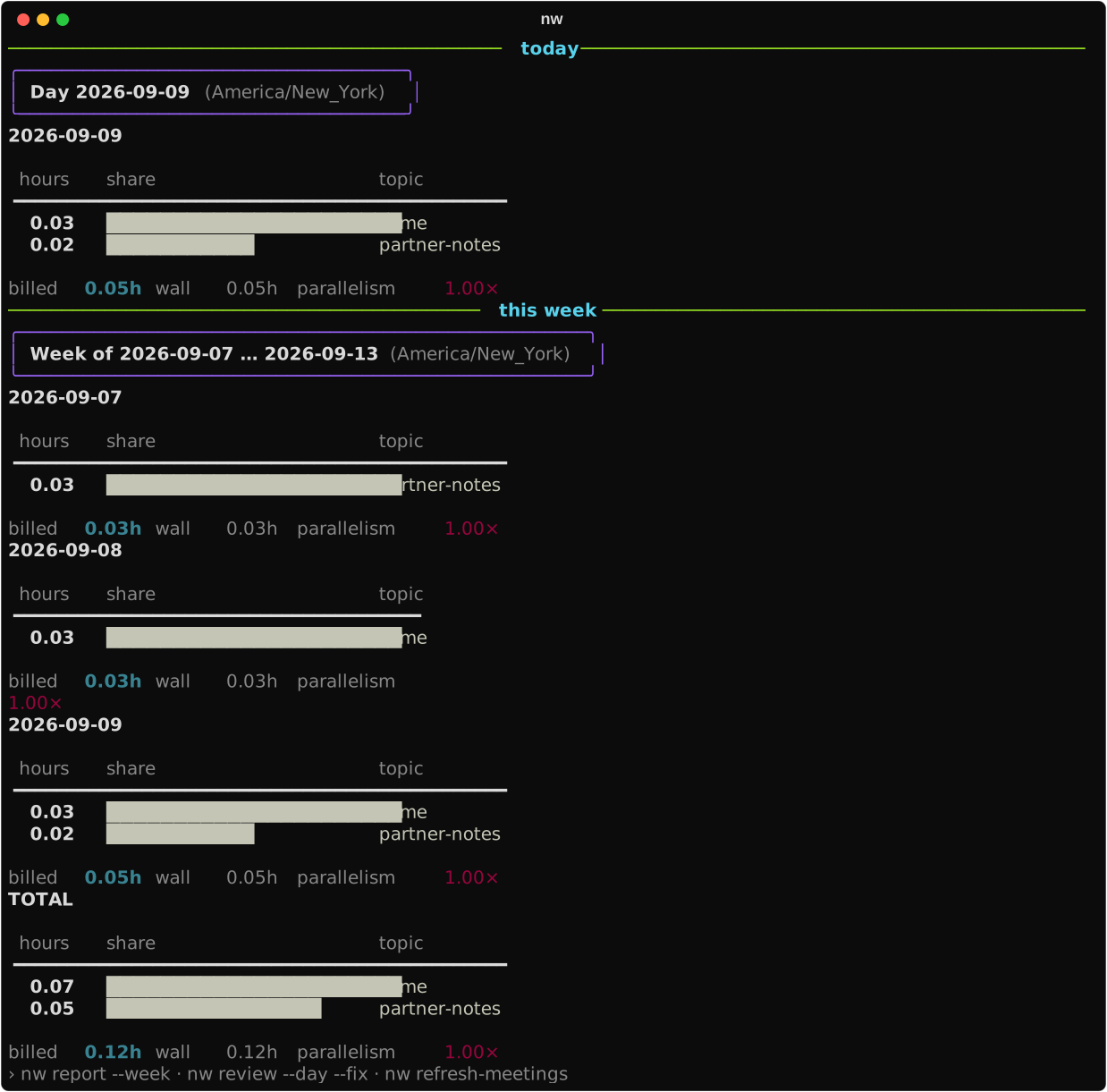
Passive time per topic from your Claude Code / Cursor transcripts and meetings. No timer for that signal.
What you get
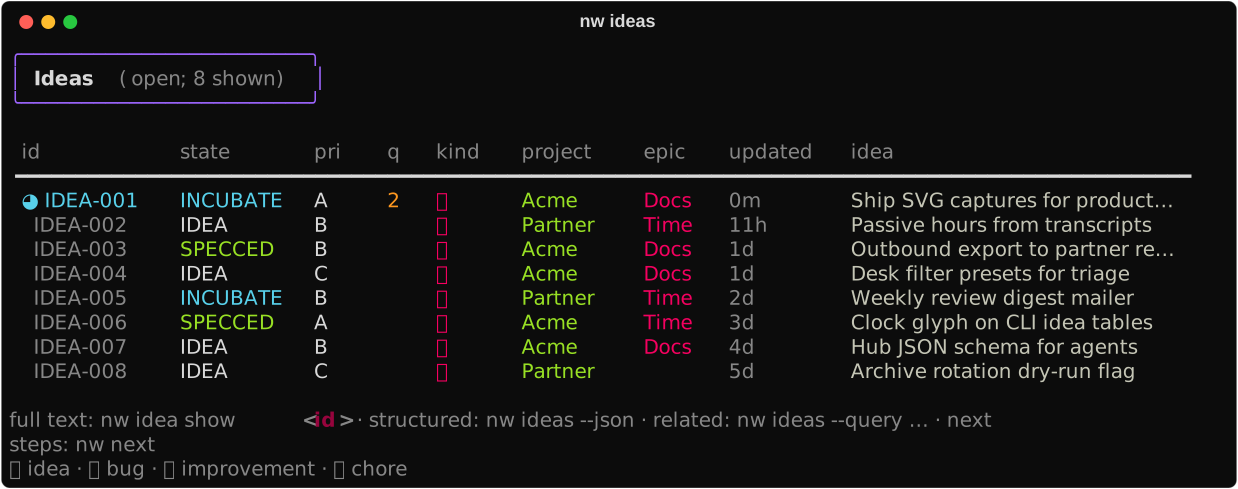
| Ideas you own | Plain-text org files with stable ids (IDEA-042), a lifecycle, and next-step hints (nw next) |
| Specs that mean something | Short governing specs: acceptance criteria and a test plan, reviewed before build, verified after (nw spec verify, /nw-verify) |
| An unattended build loop | Queue → implement → your gates → conformance review → rebase, re-gate, merge, with every step in a ledger |
| Agents in the right places | Headless personas for judgment, plain code for everything else, and a conductor session that handles the alerts |
| Passive time | Hours per topic and project, with no timer. nw idea clock-in / clock-out adds supplemental wall-time when you want it (Clock) |
You meet nightwright as a command-line tool (nw ideas, nw queue watch, nw report), as the
interactive ideas desk (nw tui), and as agent skills (/nw-explore, /nw-new-work,
/nw-conduct, …).

Find your way
| If you want to… | Go to |
|---|---|
| Set everything up, step by step | Bootstrap from zero |
| Run the loop day to day: conductor, stewards, queue | Run the agentic loop |
| Turn a vague idea into a buildable spec | Ideas to specs |
| Understand how the loop works and why | How it works · Principles |
| Know what to do when a campaign parks | Operating the loop |
| Build by hand, without the loop | Idea → ship (by hand) |
| Hand work to another repo | Outbound |
| See your hours | Track time |
| Run a day or a week with nightwright | Daily ops · Weekly ops |
| Look up a command | Reference |