How the agentic loop works
The agentic loop takes an accepted spec and turns it into merged, tested code without anyone at the keyboard. You queue the work, and the loop opens a branch, implements, tests, reviews, fixes and merges. It only comes back to you when it needs a decision.
It is built from a few plain parts. Each part does one job, and every step is written down.
The big picture
flowchart TB
    H(["👤 You"])

    subgraph SES["Sessions — Claude Code"]
        direction LR
        C["🎛️ Conductor · /nw-conduct<br/>wakes on events, decides queue actions"]
        ST["🧭 Steward · /nw-steward<br/>knows one project (optional)"]
        C <-- "mailbox" --> ST
    end

    subgraph CORE["nightwright — deterministic core"]
        direction LR
        Q[("📋 Queue<br/>backlog · waiting · slots")] --> R["⚙️ Runner · nw queue run<br/>one tick at a time"]
        R --> LG[("📒 Ledger<br/>every step, every dollar")] --> EV[("🔔 Events<br/>parks · merges · failures")]
    end

    subgraph CAMP["Per campaign — its own branch + worktree"]
        direction LR
        P["🤖 Personas · claude -p<br/>implementer · triager · reviewers"]
        G["🧪 Gates<br/>your tests and linters"]
    end

    MAIN[("🌿 main")]

    H -- "nw queue add" --> Q
    R -- "runs" --> P
    R -- "runs" --> G
    R -- "rebase · re-gate · merge" --> MAIN
    EV -- "wakes" --> C
    C -- "resume · park · abandon" --> Q
C -- "escalates when the table says so" --> H| Part | What it is | What it does |
|---|---|---|
| Queue | Campaign state files under <data_dir>/agentic/ |
Holds the backlog (not started), what's waiting for a slot, what's active, what's parked |
| Runner | One nw queue run process holding a lease |
Each tick: admit work into free slots, run the next step of every active campaign, record everything |
| Campaign | One spec's trip through the loop | Has its own branch and worktree, a state, counters, a cost, and an append-only ledger |
| Personas | Fresh headless claude -p runs |
Do the judgment work: implement, triage a failing gate, review. Each run starts with fresh context and a budget |
| Gates | Shell commands from .nw/project.yaml |
Your tests and linters, run deterministically in the worktree. Gates are where code meets reality |
| Event stream | A projection of every ledger | Turns "campaign parked", "merged", "runner dead" into alerts |
| Conductor | A long-lived Claude Code session | Wakes on events and decides from a fixed decision table. It never implements anything |
| Steward | A project session (optional) | Answers project questions the conductor asks over the mailbox |
| You | — | You're asked only when the conductor's table says so |
One campaign, end to end
sequenceDiagram
    autonumber
    actor You
    participant Q as Queue / Runner
    participant NIGHTWRIGHT as Worktree
    participant I as Implementer
    participant G as Gates
    participant Rv as Reviewer
    participant M as main

    You->>Q: nw queue add SPEC-0042 --yes
    Q->>Q: backlog → admitted when a slot is free
    Q->>NIGHTWRIGHT: create branch + worktree, run setup
    loop until gates pass and review passes (bounded)
        Q->>I: implement (spec + last findings)
        I->>NIGHTWRIGHT: edit, commit
        Q->>G: run gates in the worktree
        alt a gate fails
            Q->>Q: triager decides: fix / retry / waive / escalate
        else gates pass
            Q->>Rv: conformance review vs the spec
            Rv-->>Q: pass or fix (with findings)
        end
    end
    Q->>M: rebase on main, re-run gates, fast-forward merge
    Q-->>You: merged (or parked with a reason, if it got stuck)
Everything in that diagram is written to the campaign's ledger as it happens: every state
transition, persona run, gate result, finding and dollar. nw campaign log <id> replays it,
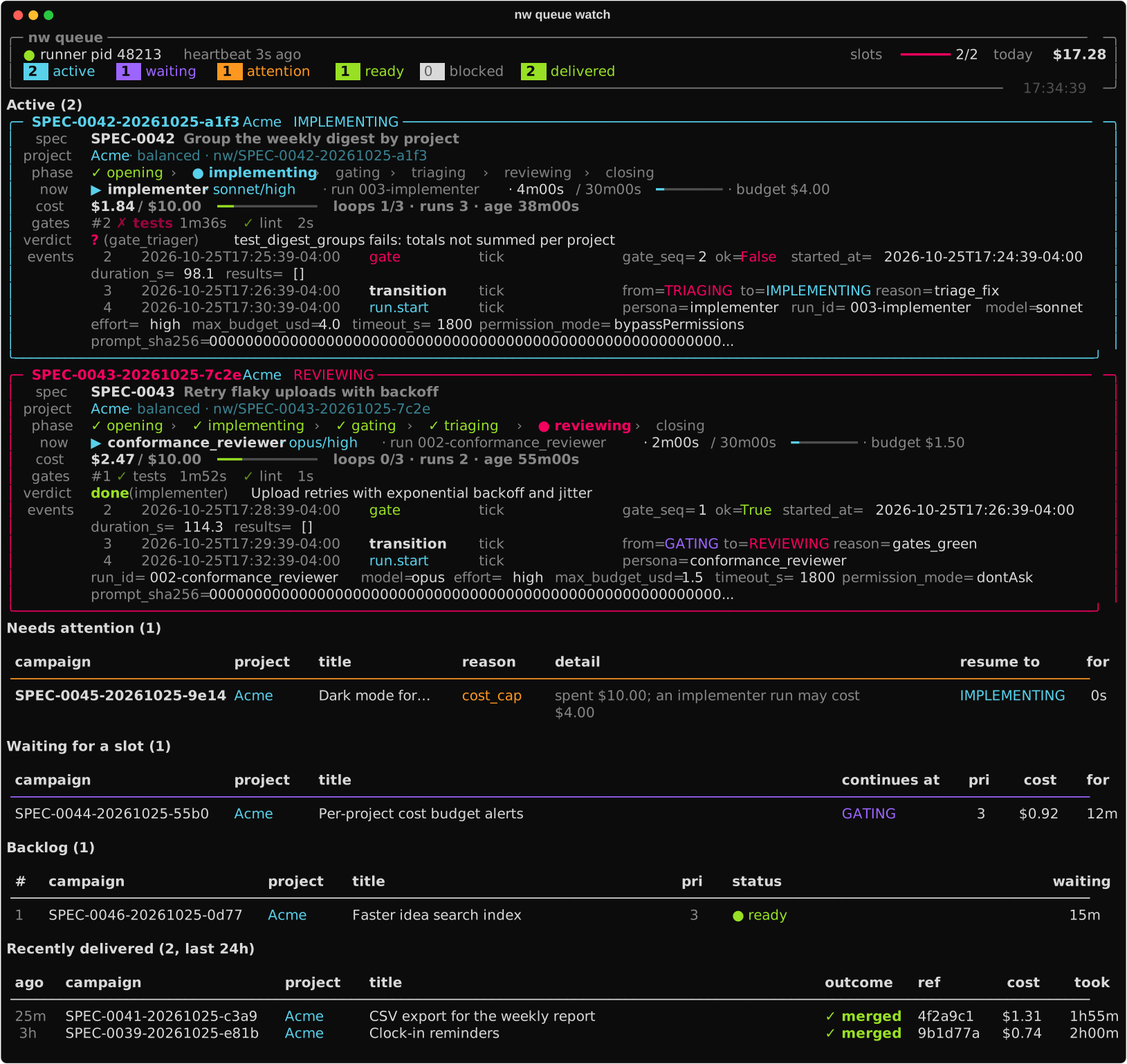
and nw queue watch shows it live.
Where to go next
- Principles — why it's built this way, and what it will never do.
- The state machine — every state a campaign can be in, and every move between them.
- Convergence and escalation — how loops are kept short, and what happens when they aren't.
- Operating the loop — starting it, watching it, and what to do when something parks.
New here? Start with Bootstrap from zero. To get good specs into the loop, read Ideas to specs.