Capture ideas
Capturing should cost seconds, so that nothing worth keeping gets lost and nothing breaks your flow. Shape comes later, when you explore.
flowchart LR
    subgraph where["Where the thought comes from"]
        A["a passing thought"]
        B["a conversation<br/>with an agent"]
        C["a bug you just hit"]
    end
    A -- "nw idea …" --> I[("ideas.org<br/>IDEA-NNN")]
    B -- "/nw-seed" --> I
    C -- "nw idea capture --kind bug" --> I
    I -. "check first" .- R["/nw-related<br/>nw ideas --query"]
The one-liner
nw idea "Weekly digest should group by project"
That's all you need. The idea gets the next free IDEA-NNN id and state IDEA, plus
:CREATED: / :UPDATED: stamps.
Adding just enough shape
Add any of these at capture time, or later. They are what make an idea findable and routable:
nw idea capture "Queue watch should show review rounds" \
    --project Meta-Tools \
    --epic SPEC-0169 \
    --kind improvement
| Field | Why it matters |
|---|---|
--project |
Which project (repo) the work belongs to. It routes the spec to the right place, and the right queue |
--epic |
The umbrella spec this belongs to. Its spec becomes a child of that epic |
--kind |
idea, bug, improvement or chore, for triage and filtering |
| priority | nw idea priority IDEA-NNN --set A (A/B/C) |
| tags | nw idea tags IDEA-NNN --set ui,perf |
From a conversation
When a chat with an agent has already shaped a thought, don't retype it. /nw-seed
distills the conversation into an idea with a title, an optional Summary and a Log entry,
so the context survives the session.
Check before you capture
Ideas are global and long-lived, so the same thought often already exists, sometimes as a closed idea with a lesson attached:
nw ideas --query "review rounds" # open and closed ideas, ranked
In an agent session, /nw-related does this search and tells you whether to capture a new
idea, add to an existing one, or reopen a closed one.
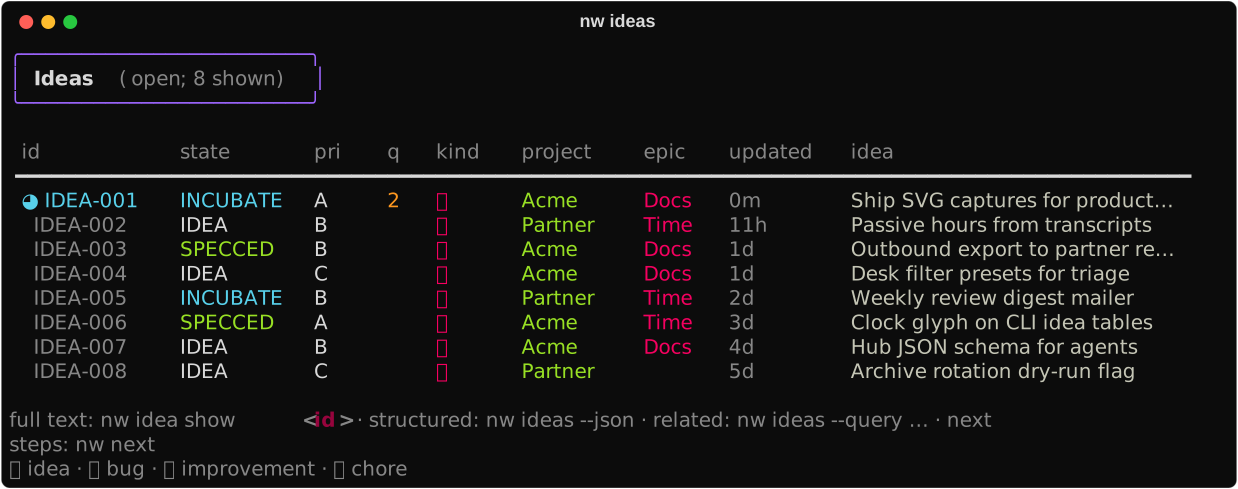
Seeing what you have
nw ideas                   # open ideas
nw ideas --project Acme    # one project
nw next                    # every open idea with its next command
nw tui                     # the desk: browse, edit, change state
Next: Explore until it's ready.